
The Fantasy Draft Paradox: Why Your App Says Draft the RB Who Scores Fewer Points
How ESPN and Sleeper's algorithms actually work—and why waiting on QB until Round 4 is mathematically sound

The Setup
In a 10-team half-PPR league, Lamar Jackson averaged 25.6 points per game in 2024. Saquon Barkley averaged 22.2. So why do fantasy apps recommend drafting Barkley in Round 1 and waiting until Round 4 or later for Jackson?
The answer? Fantasy platforms rank players using Value Over Replacement Player (VORP) and other factors, not just raw points. Comparing quarterbacks to running backs is an apples-to-oranges situation and requires a different approach.
What is VORP? VORP measures how many more points a player scores compared to a readily available replacement player at the same position.
If you drafted Lamar Jackson but he got injured, you could probably find Kyler Murray on waivers and still get decent QB production. But if you drafted Saquon Barkley and he got injured, your replacement options are going to be much, much worse.
The replacement player is typically defined as the worst viable starter in your league format. In a 10-team league, that's roughly the 10th-best QB, 20th-best RB, or 20th-best WR.
The VORP Data: Why the Numbers Tell a Different Story
The most revealing aspect of VORP analysis comes from examining how value drops off at each position. Unlike raw scoring, VORP tells us the true cost of waiting on different positions.
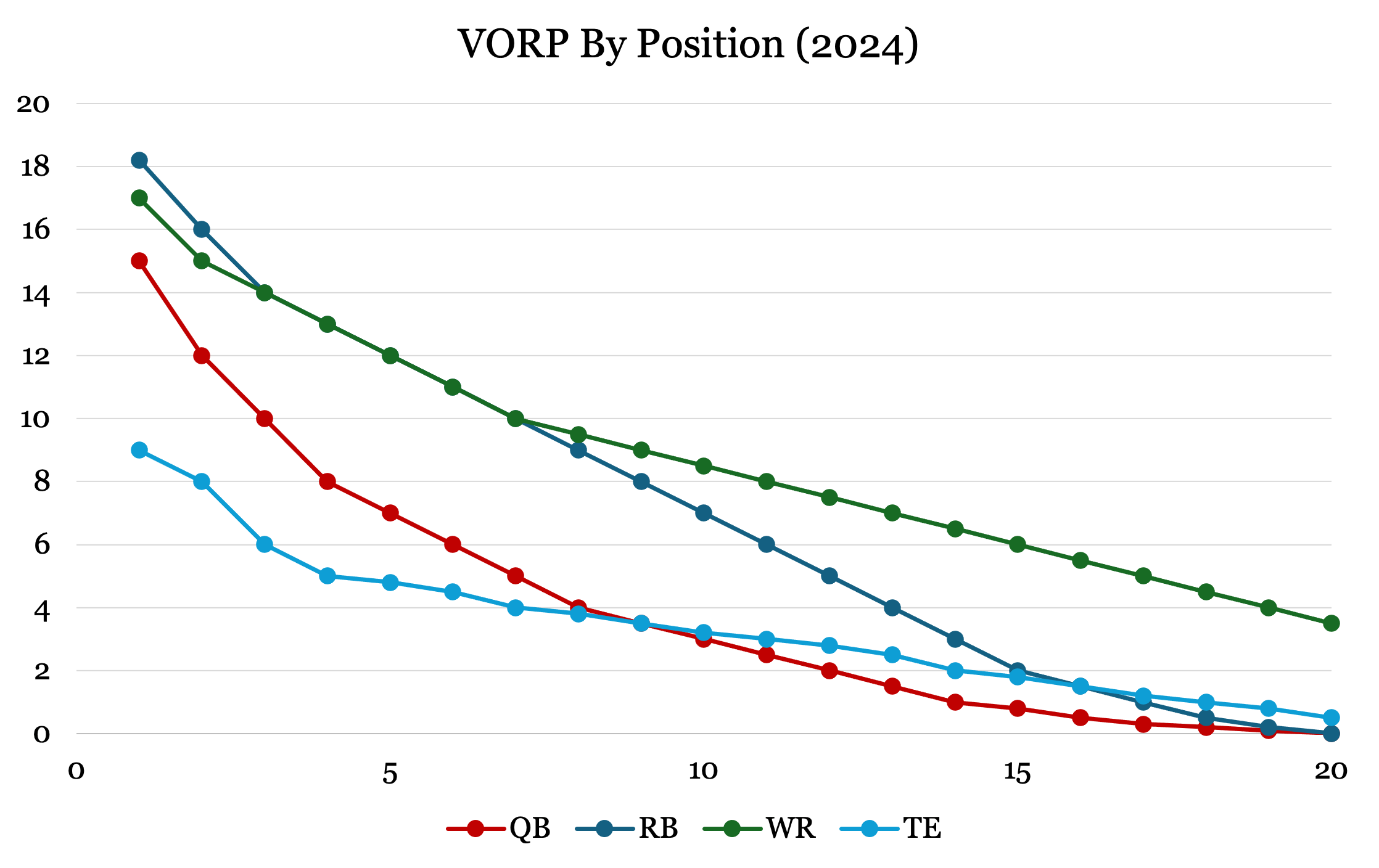
The chart above demonstrates the mathematical foundation behind the "wait on QB" strategy you've heard. Notice how RBs and WRs maintain higher VORP values deep into the rankings, while QBs and TEs (positions more commonly streamed on a weekly basis) drop off quickly.
Ranking algorithms aren't just looking at who scores the most points—they're calculating who provides the most incremental value over easily accessible replacements.
How Fantasy Apps Actually Calculate Rankings
ESPN and Sleeper don't just sort players by projected points. Their algorithms follow a more sophisticated process based on value-based drafting principles:
1. Project seasonal fantasy points for each player
2. Calculate VORP using position-specific replacement baselines
3. Apply positional scarcity multipliers based on lineup requirements (you start 2-3 RBs but only 1 QB)
4. Weight by consistency and injury risk factors
When ESPN ranks Josh Allen 31st overall, they're not saying he's the 31st-best fantasy player. They're saying he provides less incremental value over replacement than 30 other players.
The 2024 Season Proves VORP Theory
Let's examine how this played out in practice during the 2024 season:
Quarterback Value vs. Replacement:
· Lamar Jackson (QB1): 434.4 total points, 25.6 PPG
· Kyler Murray (QB12, replacement level): 308.2 total points, 18.1 PPG
· Difference: Murray produced 71% of Lamar’s PPG
Running Back Value vs. Replacement:
· Saquon Barkley (RB1): 355.3 total points, 22.2 PPG
· Rachaad White (RB24, replacement level): ~174.1 total points, 10.9 PPG
· Difference: White produced 49% of Saquon’s PPG
You could get most of Lamar's production from the waiver wire, but elite RB production is impossible to replace.
Why VORP Matters for Your Draft Strategy
Understanding VORP can help drive your draft strategy in standard leagues:
· Rounds 1-3: Attack High-VORP Positions such as RB and WR
· Rounds 4-6: Consider Elite QBs, especially with rushing upside
· Rounds 7+: QB streaming becomes viable. Focus on high-upside players
The Lineup Construction Factor
Even if QB1 outscores RB1 by 3 points per week, you need multiple startable RBs. Missing out on early RBs means your RB2 and Flex spots become massive weekly disadvantages that can't be overcome by a single elite QB.
Why Apps Like ESPN and Sleeper Rank This Way
The algorithms are essentially optimizing for opportunity cost. They're asking: "If you draft this player, what are you giving up at other positions?"
When you draft a QB early, you're not just getting a QB—you're passing up on a scarce RB or WR. The apps calculate whether that trade-off is worth it based on VORP across all positions.
Fantasy apps have incorporated these principles because they tend to yield better results than rankings based solely on projected points. The mathematics of value-based drafting has been proven across multiple seasons and league formats.
The Bottom Line
Fantasy apps rank players based on VORP because it measures true fantasy value, not just raw scoring potential.
This is why "wait on QB" isn't just conventional wisdom—it's often the most efficient strategy for value-based drafting. The apps have long used value-based principles in their rankings.
Understanding VORP gives you the framework to evaluate any draft decision. Ask yourself: "How much value am I gaining over replacement at this position versus other positions?”
A Word of Caution
This analysis focused on the 2024 NFL season. However, fantasy managers must monitor notable injuries to top players and the sudden rise (or lack of) young talent at specific positions. This will greatly influence draft strategy and VORP. Tight end is a great example of this, with a lot of variance in depth year over year.
Sources
3. https://fanarena.com/what-is-glossary/value-over-replacement-player-vorp/
5. https://www.fantasypros.com/2024/08/what-is-positional-scarcity-drafting-in-fantasy-football/
6. https://www.draftsharks.com/article/fantasy-football-draft-strategy-guide/12-team-half-ppr
10. https://www.pff.com/news/fantasy-football-season-2024-in-review-quarterbacks
12. https://football.pitcherlist.com/fantasy-football-draft-strategy-hero-rb/
13. https://fantasyfootballanalytics.net/2014/07/identify-fantasy-football-sleepers-app.html
14. https://www.espn.com/blog/playbook/fandom/post/_/id/6261/academic-algorithm-takes-on-fantasy-sports
15. https://www.espn.com/fantasy/basketball/fba/story?page=fbarulesrankings